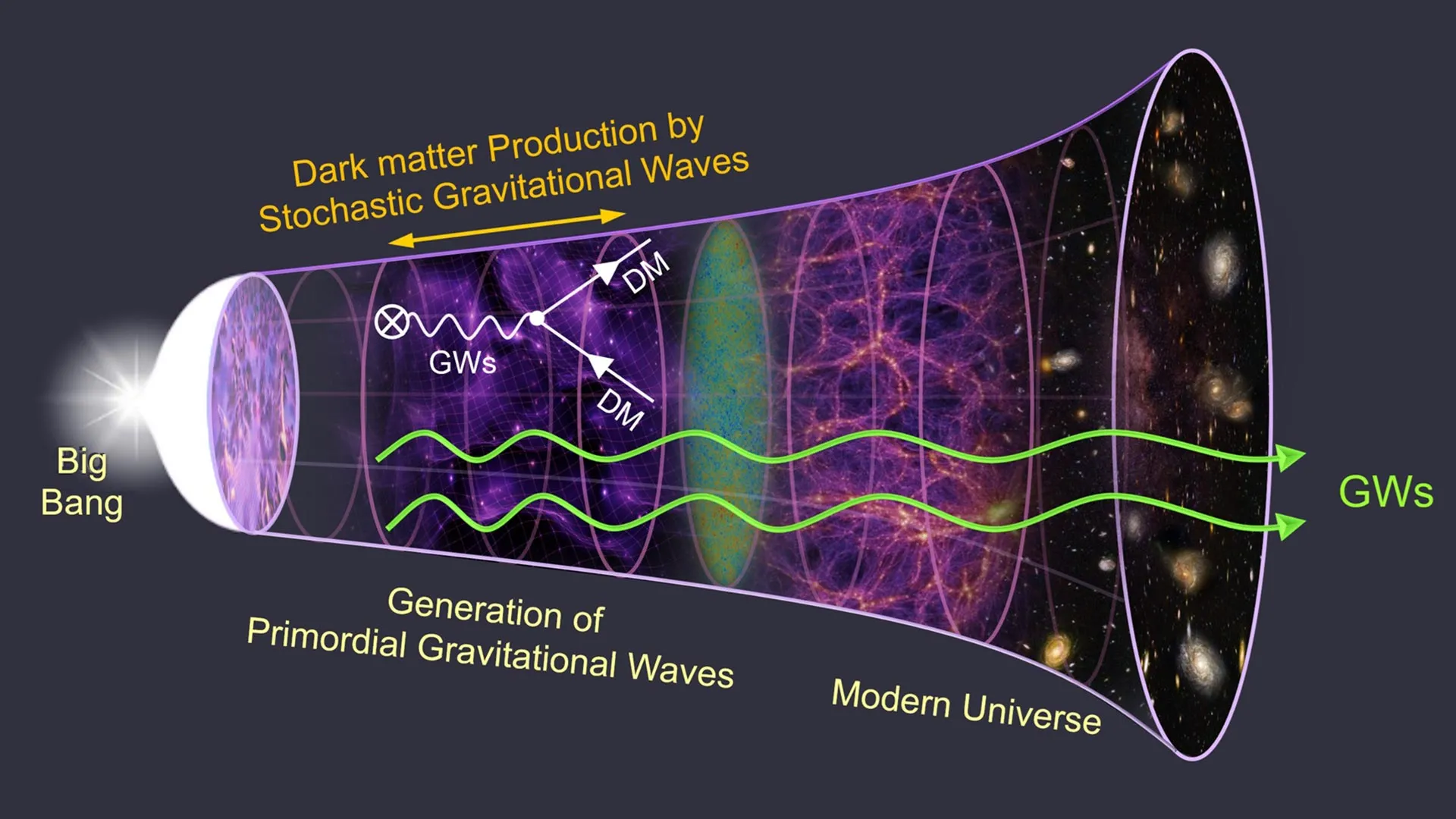
** Scientists have proposed a groundbreaking mechanism suggesting that ripples in spacetime could have birthed the mysterious substance that makes up most of the universe.
📍 ** Mainz, Germany (with international collaboration in Swansea, UK)
**
The quest to understand dark matter, which comprises approximately 23% of the universe and governs the formation of galaxies, has taken a surprising turn. A new study, published in *Physical Review Letters*, proposes a link between stochastic gravitational waves – faint ripples in spacetime – and the creation of dark matter particles during the universe’s earliest moments. Led by Professor Joachim Kopp of Johannes Gutenberg University Mainz and Dr. Azadeh Maleknejad from Swansea University, the research offers a novel perspective on how this invisible substance might have emerged.
The current understanding of cosmology relies heavily on the existence of dark matter, despite our inability to directly observe it. Dark matter’s gravitational influence shapes the cosmos, and scientists are actively exploring numerous theories to determine its composition. This new theory leverages the detection of incredibly ancient gravitational waves, remnants of events like black hole collisions and phase transitions in the early universe, suggesting a pathway for these waves to transform into fundamental particles – specifically, fermions – which could then evolve into the dark matter we observe today.
This research addresses a critical gap in our knowledge and points to a potentially dominant mechanism for dark matter formation. Moving forward, the team plans to refine their calculations with more sophisticated numerical simulations and further investigate the potential influence of gravitational waves on early universe processes, potentially unlocking a deeper understanding of the cosmos's origins.
**
Original Source: Link
** #DarkMatter #GravitationalWaves #Cosmology #ParticlePhysics #BigBang #EarlyUniverse #SpaceResearch #Astrophysics