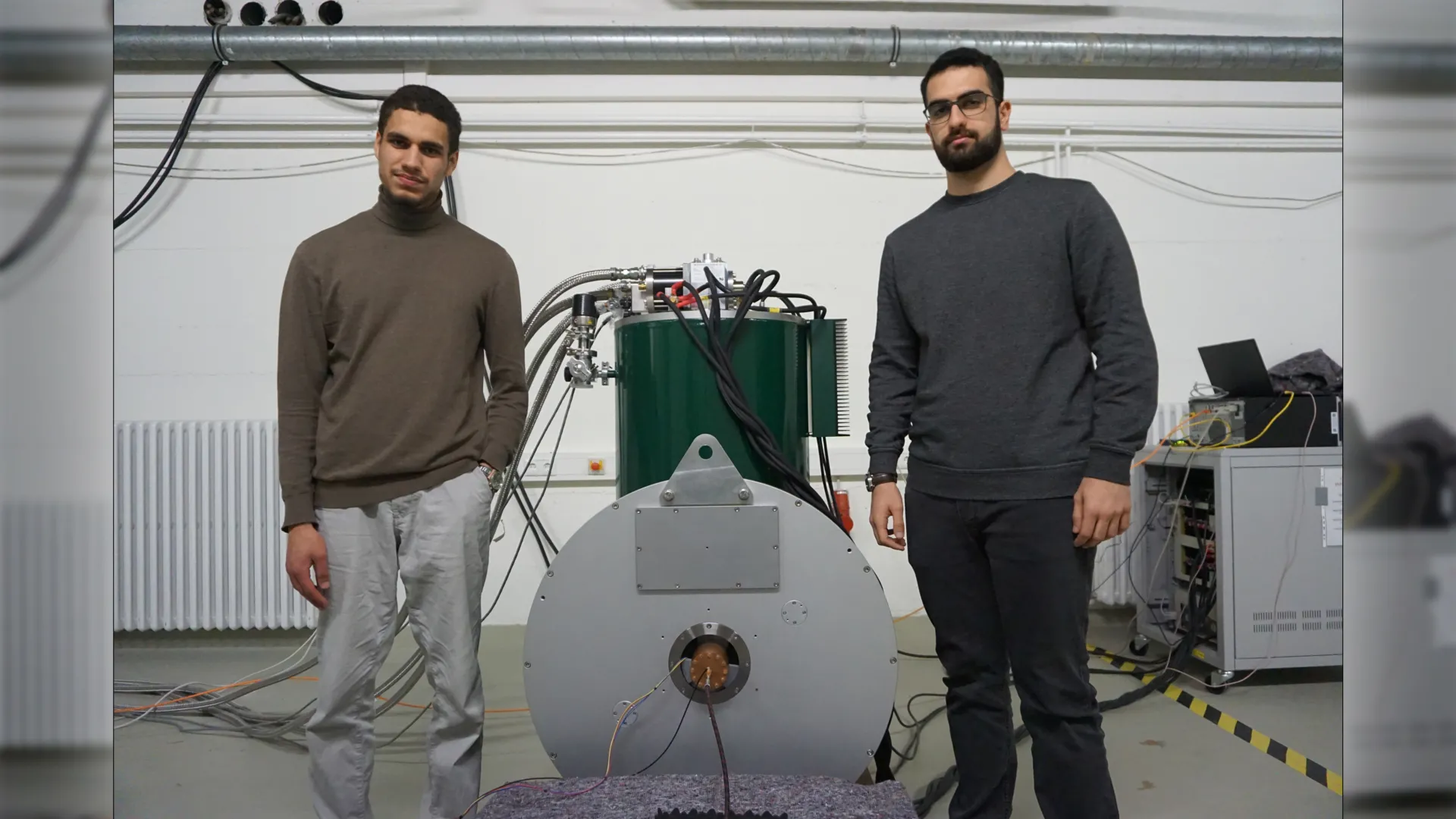
** Innovative student-led experiment demonstrates that impactful scientific breakthroughs can emerge from modest resources and creative approaches.
📍 ** Germany, Hamburg
**
Modern cosmology often relies on enormous observatories and multi-billion dollar collaborations, but a recent study published in the Journal of Cosmology and Astroparticle Physics (JCAP) highlights the potential for significant progress even with smaller, more focused teams. The research focuses on the complex search for dark matter, specifically axions, a leading candidate for its composition.
A group of undergraduate students from the University of Hamburg developed and built a cavity detector designed to hunt for axions. Despite working with limited funding – supported by a student research grant from the University of Hamburg’s Hub for Crossdisciplinary Learning – they achieved a noteworthy result: establishing new experimental limits on axion properties. This success underscored the fact that dedicated, smaller experiments, when bolstered by institutional support, can still make crucial contributions to tackling some of physics’ most challenging problems.
The team’s work was deeply intertwined with the larger MADMAX dark matter experiment, benefiting from the expertise of established researchers and access to sophisticated equipment like a magnet, provided by the University of Hamburg and the Quantum Universe Cluster of Excellence. The project, initiated by Agit Akgümüs and Nabil Salama, involved constructing a relatively simple, resonant cavity detector, demonstrating a pragmatic approach to experimentation.
**
Original Source: Link
** #DarkMatter #Axions #Cosmology #Astrophysics #StudentResearch #UniversityofHamburg #JCAP #ExperimentalPhysics