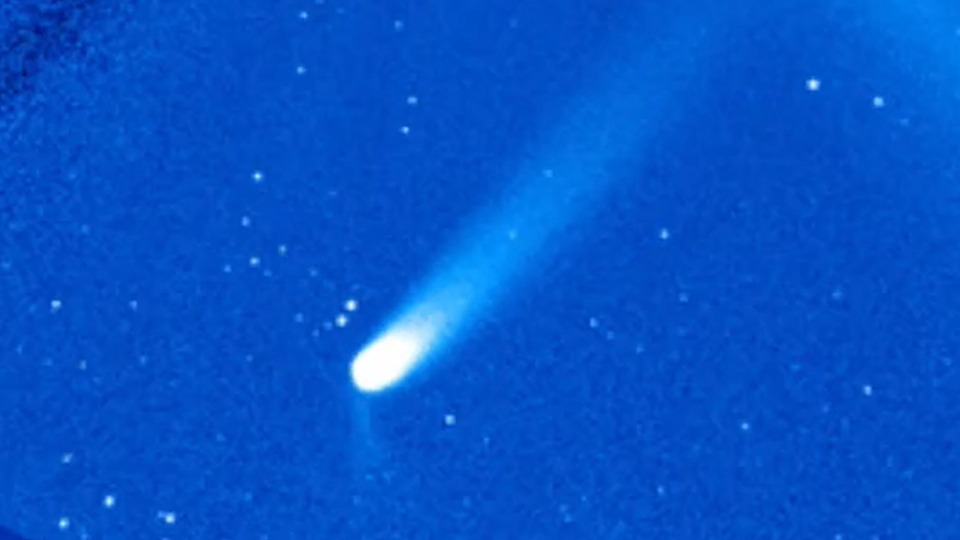
** A unique view of Comet C/2025 R3 (PanSTARRS) captured by a spacecraft revealed the stunning spectacle of its ion tail “switching on” and drifting away from the sun.
📍 ** England, United Kingdom
**
Comet C/2025 R3 (PanSTARRS) has captivated the public and the scientific community since its discovery in September 2025, generating considerable excitement about its potential to become a prominent comet. The wandering comet put on an impressive show in the weeks leading up to its close approach to Earth, drawing attention to the possibility that it could brighten enough to be recognized as a “great comet” during 2026. The comet's approach presented an opportunity for spectacular observations and stunning imagery.
The observation was made possible by the joint NASA/ESA Solar and Heliospheric Observatory (SOHO)'s coronograph, which captured incredible footage of the comet’s ion tail as it moved past the sun, shifting to a position directly away from the sun’s light. Scientists explained that this behavior is due to the comet’s formation, where solar radiation causes material locked inside the comet's solid nucleus to escape through a process called sublimation, releasing dust and gas into space.
The comet’s ion tail, driven by the solar wind, appears straight, while the dust tail lags behind, stretching for millions of miles and reflecting sunlight brilliantly. This dual-tail formation is a common phenomenon for comets as they interact with the sun's powerful radiation and wind, offering astronomers a unique window into the processes shaping these distant celestial objects.
**
Original Source: Link
** #CometPanSTARRS #SpaceExploration #Astrophotography #SolarWind #Comets #NASA #ESA #SOHO