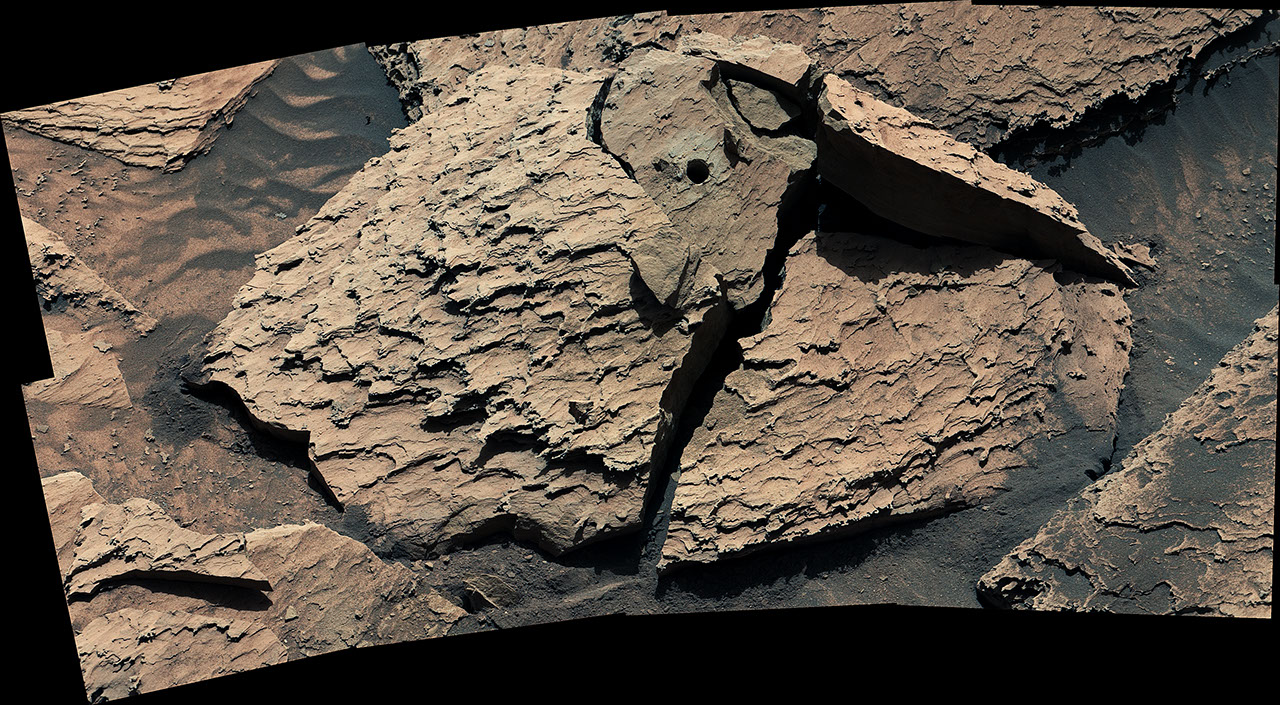
NASA’s Curiosity rover successfully detached a stubborn rock nicknamed “Atacama” after a challenging week of operations.
📍 Pasadena, California, USA; Mars
The Curiosity Mars rover, operating on the 4,877th Martian day, or sol, of its mission on May 6, 2026, captured a remarkable image of a rock that had become firmly lodged to its robotic arm’s drill. The incident occurred on April 25th, and engineers immediately began a painstaking process of repositioning the arm and applying vibrations to dislodge the rock. After several days of effort, they finally succeeded in detaching “Atacama” on May 1st, marking a significant milestone for the mission’s ongoing scientific investigations.
The “Atacama” rock itself is quite substantial, estimated to be 1.5 feet in diameter at its base and 6 inches thick, weighing approximately 28.6 pounds (13 kilograms) on Earth – roughly a third of that on the Martian surface. The circular hole created by the rover’s drill is clearly visible in the image, providing valuable insight into the drilling process and the rock’s composition. The mosaic image was created from eight individual photographs, meticulously stitched together back on Earth to accurately recreate the scene’s color under daytime conditions.
This mission highlights the complexities and challenges inherent in robotic exploration of another planet. Developed by NASA’s Jet Propulsion Laboratory, managed by Caltech, and operated by Malin Space Science Systems, Curiosity continues to provide crucial data about Mars’ past habitability. For more detailed information about this and other Curiosity rover findings, you can visit science.nasa.gov/mission/msl-curiosity.
Original Source: Link
#MarsExploration #CuriosityRover #SpaceRocks #NASA #RoboticArm #MarsScience #RedPlanet #SpaceTech