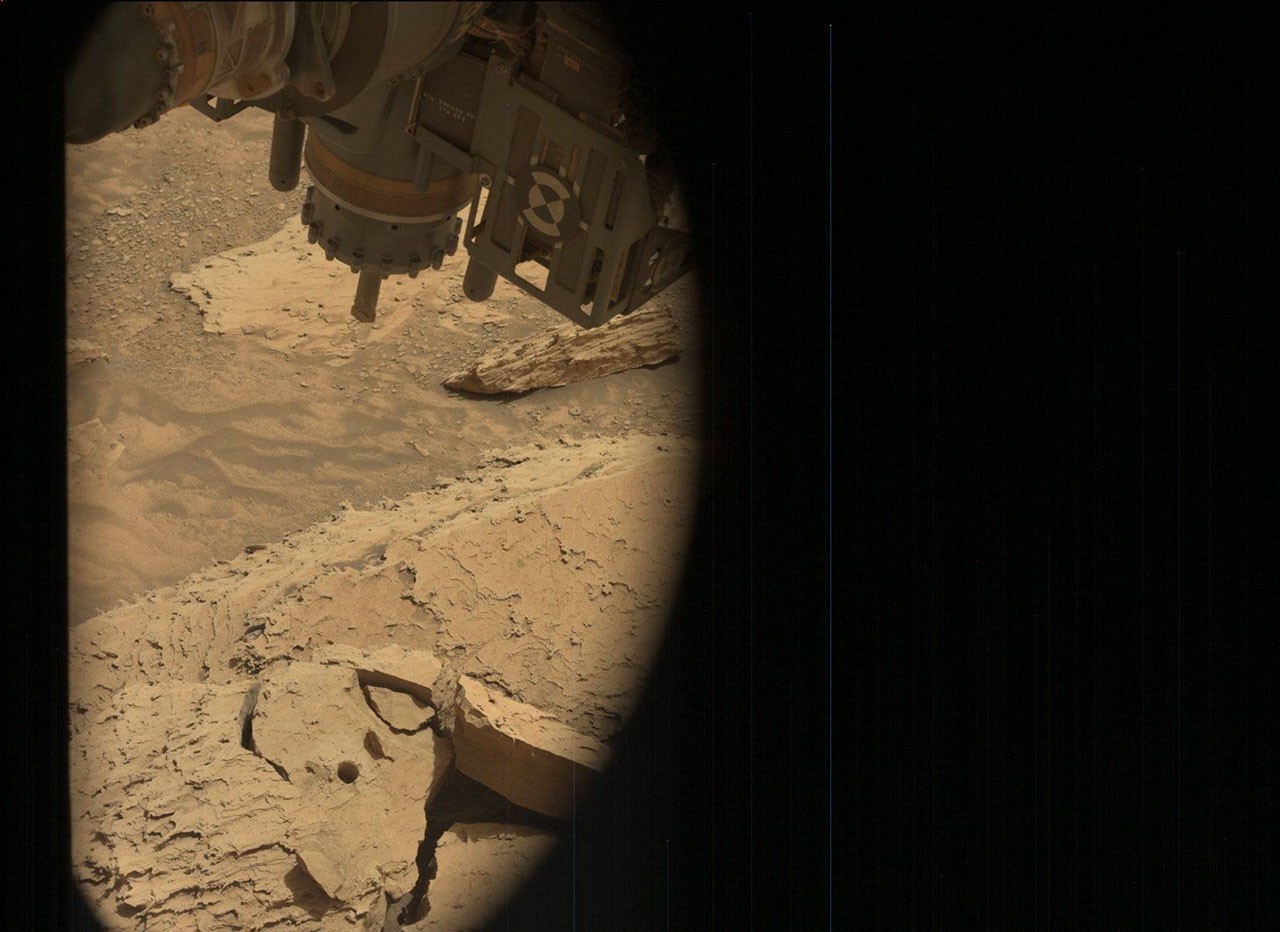
Curiosity’s mission to unravel Mars’ secrets faced a surprising challenge with a stubborn rock block, ultimately leading to valuable scientific observations.
📍 Mars, Atacama Desert, United States
The NASA Curiosity rover experienced a peculiar setback on May 2, 2026, during its exploration of the Atacama drill target. While initial data indicated a successful drill hole, the rock being extracted was actually a detached block that came along with the drill bit as the rover’s arm attempted to lift it. This unexpected situation, occurring on Martian day 4,883 of the Mars Science Laboratory mission, temporarily halted the planned in-situ science. The rover team, led by William Farrand at the Space Science Institute, swiftly developed a plan, utilizing maneuvers to rotate the drill bit and block, alongside percussion attempts to dislodge the stone. Ultimately, through a series of meticulous efforts spanning Sol 4883-4885, they successfully freed the drill bit from the Atacama block.
Despite the initial delay, the team utilized the opportunity for remote sensing activities. Focusing on areas surrounding the extraction site, Curiosity employed its ChemCam instrument to conduct LIBS measurements of several rock formations – “Pichiacani,” “Poco a Poco,” and “El Plomo” – along with passive reflectance scans of nearby blocks. Mastcam was deployed to document these measurements and perform change detection imaging of the “Playa los Metales” target. This strategic shift allowed for continued data collection even while the team worked to resolve the physical obstacle.
The subsequent plans, utilizing Sol 4881-4882, further expanded the investigation, utilizing LIBS scans of “El Turbio” and Mastcam’s continued change detection on “Playa los Metales,” alongside extending the “Kimsa Chata” mosaic. Finally, the efforts to remove the Atacama block allowed for focused ChemCam observations of the granular material below, including “Cuturipa” and a wall profile named “Chaitén,” along with the observation of the “Chiloé” block previously covered. The team’s adaptability and scientific ingenuity ensured continued progress in understanding Mars' geological history.
Original Source: Link
MarsRover Curiosity NASA SpaceExploration AtacamaDesert Geology Robotics MarsScience