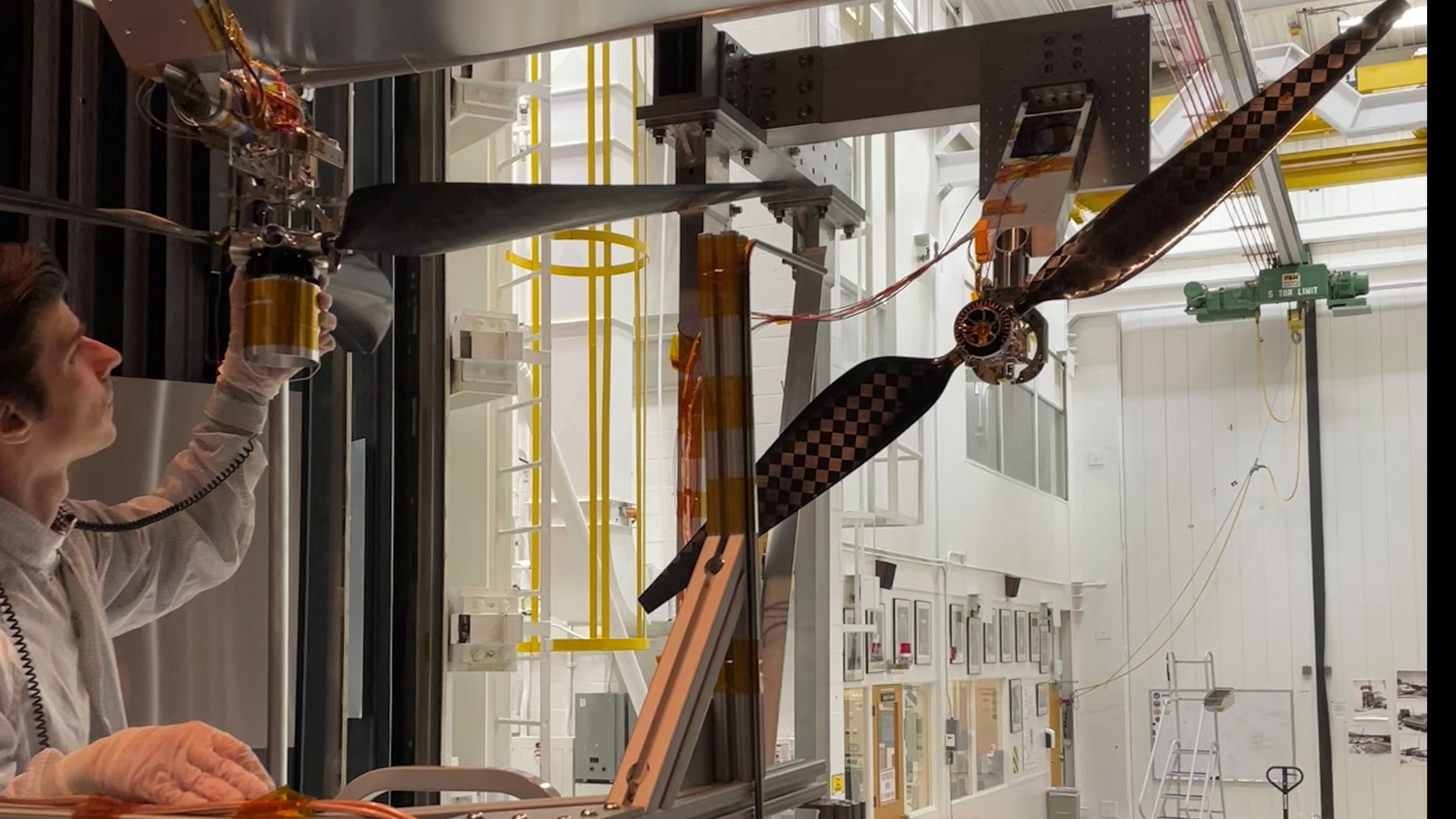
NASA’s next-generation Mars helicopters are poised to revolutionize low-altitude exploration on the Red Planet by pushing rotor blade speeds beyond the sound barrier.
📍 United States, Southern California, Pasadena
In November 2025, engineer Jaakko Karras meticulously examined a next-generation rotor blade within NASA’s Jet Propulsion Laboratory’s (JPL) 25-Foot Space Simulator. This advanced facility, located in Pasadena, California, replicates Martian environmental conditions, allowing engineers to rigorously test the performance of these ambitious aircraft. Recent tests, culminating in breaking the sound barrier during March, demonstrated the rotor blades’ ability to withstand extreme speeds – the tips accelerating beyond Mach 1 without failure. Data from 137 test runs will be instrumental in designing aircraft capable of carrying heavier payloads, including crucial science instruments for future missions.
The development stems from the success of NASA’s Ingenuity Mars Helicopter, a trailblazing technology demonstration launched over five years ago in April 2021. Ingenuity’s initial powered flight marked a historic moment – the first controlled flight on another planet. However, the upcoming next-generation aircraft are designed to significantly expand Ingenuity’s capabilities, carrying payloads like sensors and scientific instruments to gather valuable data in support of both human and robotic exploration of Mars.
Engineers are tackling the unique challenges posed by the Martian atmosphere, which is only 1% as dense as Earth’s. To generate sufficient lift, the rotor blades must reach supersonic speeds, a strategy demanding greater aggression than traditional Earth-based designs. This pursuit of speed unlocks new possibilities for low-altitude aerial exploration, promising a dramatically different perspective on the Red Planet’s surface.
Original Source: Link
MarsHelicopter NASA SpaceExploration RedPlanet Ingenuity SpaceTech JetPulsionLaboratory FutureofFlight