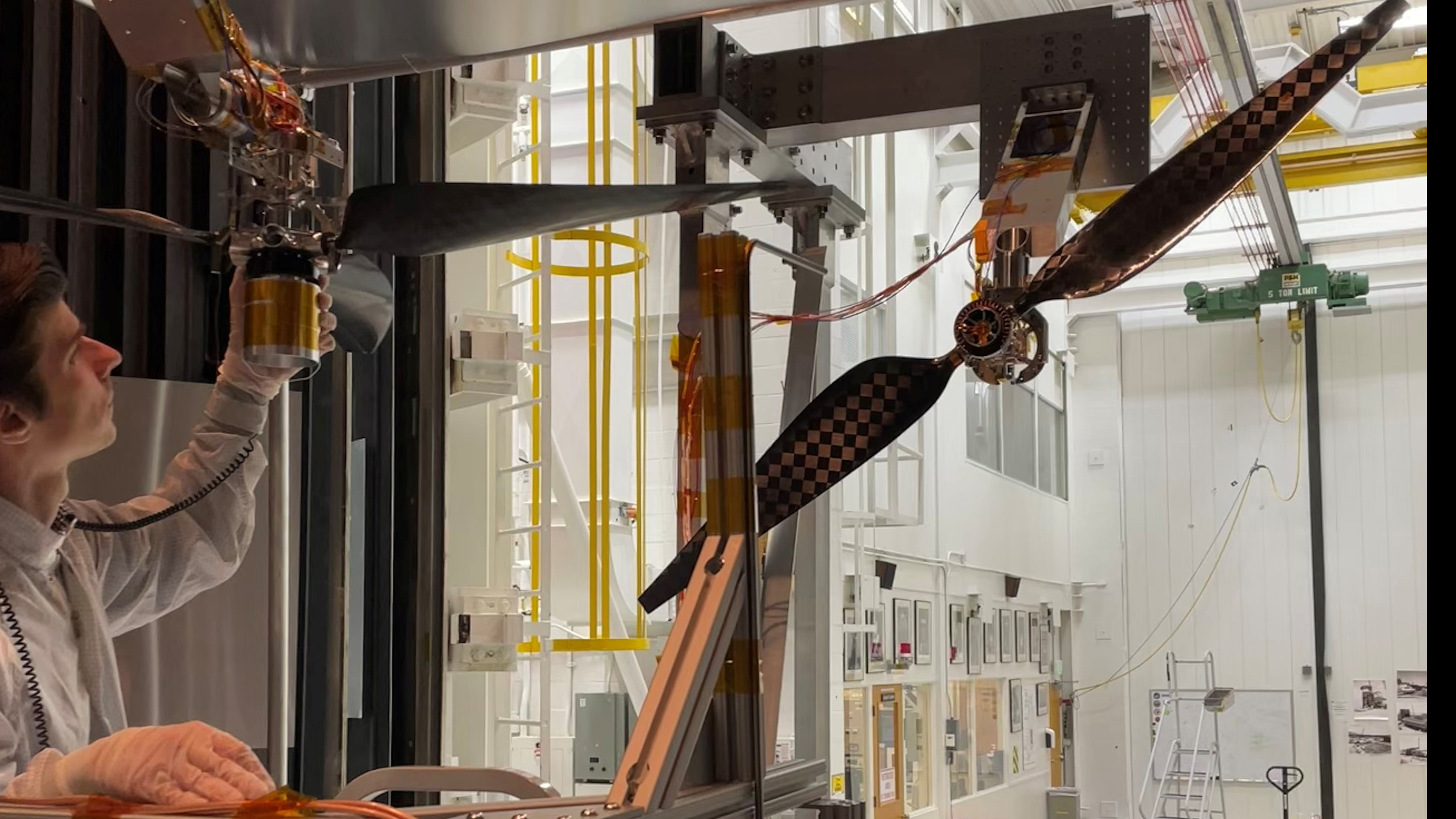
NASA’s revolutionary rotor blades have successfully achieved supersonic speeds, paving the way for ambitious aerial exploration of Mars.
📍 Southern California, United States
The rotor blades destined for NASA’s upcoming next-generation helicopters recently underwent rigorous testing at the Jet Propulsion Laboratory in Southern California, demonstrating a remarkable feat of engineering. During March tests conducted within a specialized chamber meticulously designed to replicate the challenging environmental conditions of Mars, the blades’ tips reached speeds exceeding Mach 1 – the speed of sound – without experiencing structural failure. Data accumulated from 137 individual test runs provided invaluable insights, allowing engineers to refine their designs for aircraft capable of transporting heavier payloads, including crucial science instruments necessary for groundbreaking research.
“NASA had a great run with the Ingenuity Mars Helicopter, but we are asking these next-generation aircraft to do even more at the Red Planet,” stated Al Chen, Mars Exploration Program manager at JPL. He emphasized the extreme difficulty of operating aircraft on Mars, highlighting the incredibly thin atmosphere which presents a formidable challenge for generating sufficient lift while contending with significant gravity. This advancement builds upon the success of Ingenuity, the first aircraft to achieve powered, controlled flight on another world, a pioneering technology demonstration completed over five years ago.
The recently unveiled SkyFall project and other potential future Mars aircraft represent a significant leap forward. These advanced designs will be capable of carrying valuable payloads – including sophisticated science instruments and sensors – to collect critical data in support of future human and robotic missions. By utilizing low-altitude aerial exploration, NASA aims to unlock unprecedented opportunities for scientific discovery and contribute directly to the ongoing advancement of our understanding of Mars.
Original Source: Link
MarsExploration NASA Ingenuity SpaceTech RoboticMissions RedPlanet Aviation SpaceEngineering