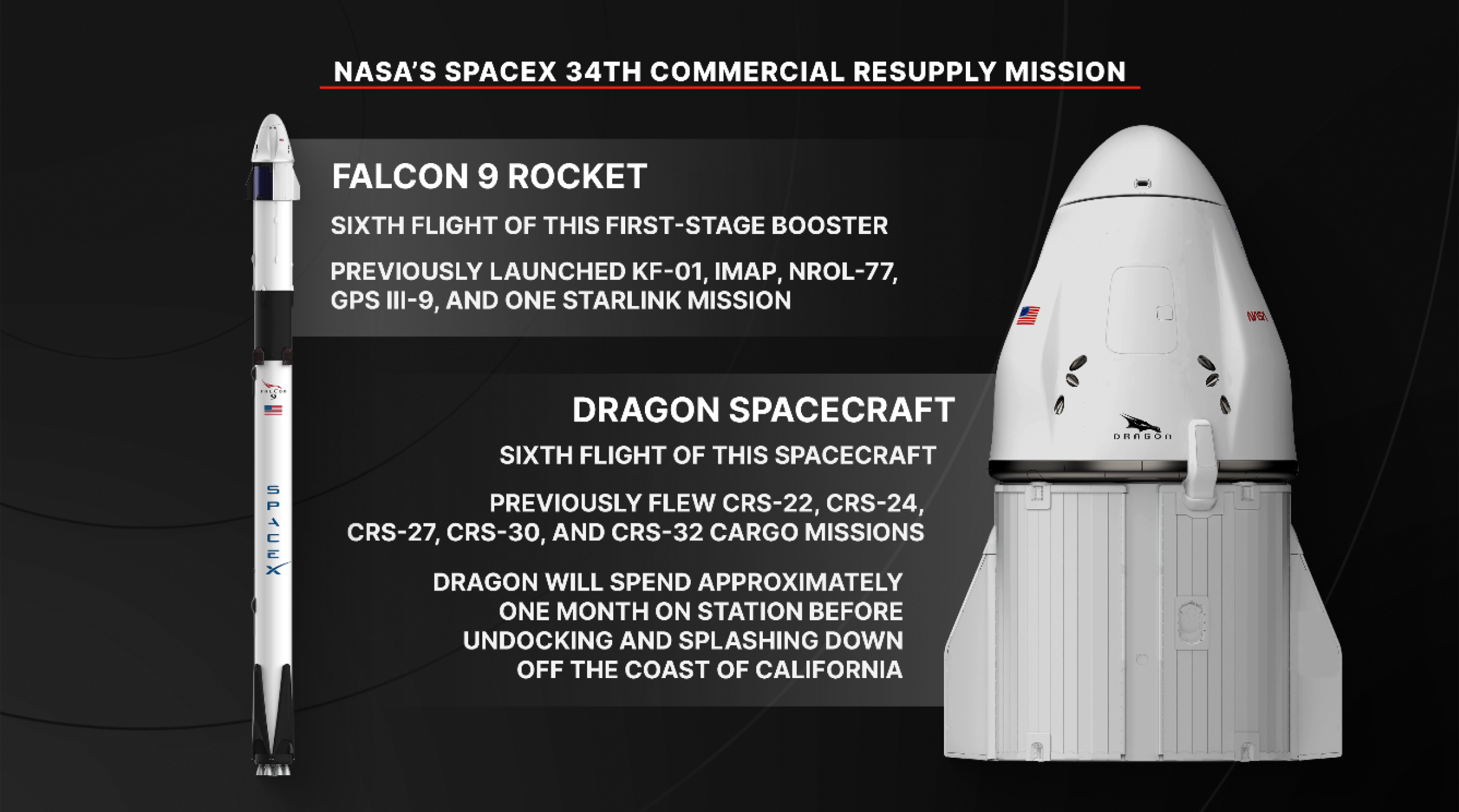
NASA and SpaceX are set to deliver vital supplies and groundbreaking research to the International Space Station in a mid-May launch.
📍 United States, Cape Canaveral Space Force Station, Florida
The ambitious NASA’s SpaceX 34th commercial resupply mission is slated for launch on the SpaceX Falcon 9 rocket, utilizing the company’s Dragon spacecraft to transport approximately 6,500 pounds of cargo to the ISS. The launch, targeted for mid-May, will originate from Launch Complex 40 at Cape Canaveral Space Force Station in Florida, marking another crucial step in continuing scientific operations aboard the orbiting laboratory. Following a successful launch, the Dragon spacecraft will autonomously dock with the Harmony module, furthering the ongoing collaboration between NASA and SpaceX in supporting vital research endeavors.
This mission isn't simply about delivering supplies; it’s a launchpad for significant scientific advancements. Dragon will carry a suite of innovative experiments, including ODYSSEY, which investigates Earth-based microgravity simulators; STORIE, focused on monitoring charged particles in orbit; LAPLACE, studying dust particle dynamics; and GREEN BONE, examining bone cell development in microgravity. These experiments will directly contribute to understanding space weather, advancing long-duration space missions, and potentially improving treatments for bone disorders.
The International Space Station, a testament to global cooperation, has been providing research capabilities for over 25 years, facilitating experiments conducted by scientists from more than 110 countries. These investigations are paving the way for future lunar and Martian exploration within the Artemis program, while simultaneously benefiting humanity through a wealth of knowledge. Viewers can follow the launch and arrival coverage live on NASA+, Amazon Prime, and NASA’s YouTube channel.
Original Source: Link
SpaceExploration ISS NASA SpaceX Microgravity ScientificResearch SpaceWeather ArtemisProgram